

Athletes often wonder if their nutrition should change between training days and rest days. It makes sense to assume that less activity would require less food; however, total energy (calorie) needs remain pretty consistent, even on days without structured exercise. What usually changes is the composition of nutrients and the timing of meals and snacks, rather than the overall quantity of food.
Why Your Caloric Needs Stay Relatively Stable
Rest days require a considerable amount of energy. Your body is working hard repairing muscle and connective tissue, restoring glycogen, and allowing for CNS recovery. If intake drops too low on rest days, you may feel sluggish, recover more slowly, or notice reduced performance the next time you train. Over time, it can also lead to something called, RED-S.
What Actually Changes: Nutrient Pattern and Timing
Instead of reducing overall intake, it’s more effective to adjust the nutrients emphasized and when they’re consumed. (For a more detailed breakdown based on activity type, see our blogs, What to Eat Before, During, and After a Lifting Session and What to Eat Before, During, and After a Cardio Session).
| Intake | Training Day | Rest Day |
|---|---|---|
| Calories | Adequate to support development and training demands. | Similar to training day. Athletes should NOT cut calories. |
| Carbohydrates | Higher, consider timing. | Slightly less, may be able to include more complex carbs/fibrous options, such as vegetables. |
| Protein | Spread consistently throughout the day. Decrease immediately before activity and ensure adequacy after activity. | Spread consistently during the day. Timing is otherwise irrelevant. |
| Fat | Lower immediately before and after activity to optimize nutrient absorption and minimize GI upset. | Include adequate amounts with all meals. |
| Fiber | Limit before activity. | Can include with each meal. Timing is otherwise irrelevant. |
Using the Performance Plate
The performance plate provides a practical framework for adjusting meal composition based on activity level. It is best reserved for meals consumed approximately 3 to 4 hours before or after training and can be adjusted based on individual needs. For meals immediately before or after exercise, follow the specific pre- and post-workout guidelines in the table above. While these plates make an easy visual to replicate, the Performance Plate is not teen-specific or sport-specific. Here at SPP, we encourage teen and endurance athletes to incorporate more fat at their meals.
“Easy” Plate
This may be what you aim for on a rest day or active rest day. Half your plate should be fruits and vegetables, ¼ should be carbohydrate (starch), and ¼ should be lean protein. Meals for “easy” days should also include a teaspoon of fat. This plate most closely aligns with general nutrition recommendations (i.e., “MyPlate”) for non-active individuals.
“Moderate” Plate
The harder your workout, the more calories you’ll need to consume. As a general guide, meals for “moderate days” (i.e., two sessions per day, such as those targeting different energy systems) should include approximately ⅓ fruits/veggies, ⅓ carbohydrates (starch), ¼-⅓ lean protein, and 1 tablespoon of fat. This composition supports recovery and energy needs without being overly calorically dense.
“Hard” Plate
For “hard” days (i.e., days of competition, two demanding workouts, or the days leading up to and following them), your body needs significantly more energy to support high-intensity or high-volume training. Increasing both carbohydrate and fat sources provides concentrated fuel that is easier to consume and digest, since these foods are less fibrous and more calorie-dense than vegetables. Based on your “moderate” plate, you’ll adjust your intake by primarily emphasizing carbohydrates. Half your plate should be carbohydrate (starch), ¼ should be lean protein, and ¼ should be vegetables. Fat increases to 2 tablespoons.
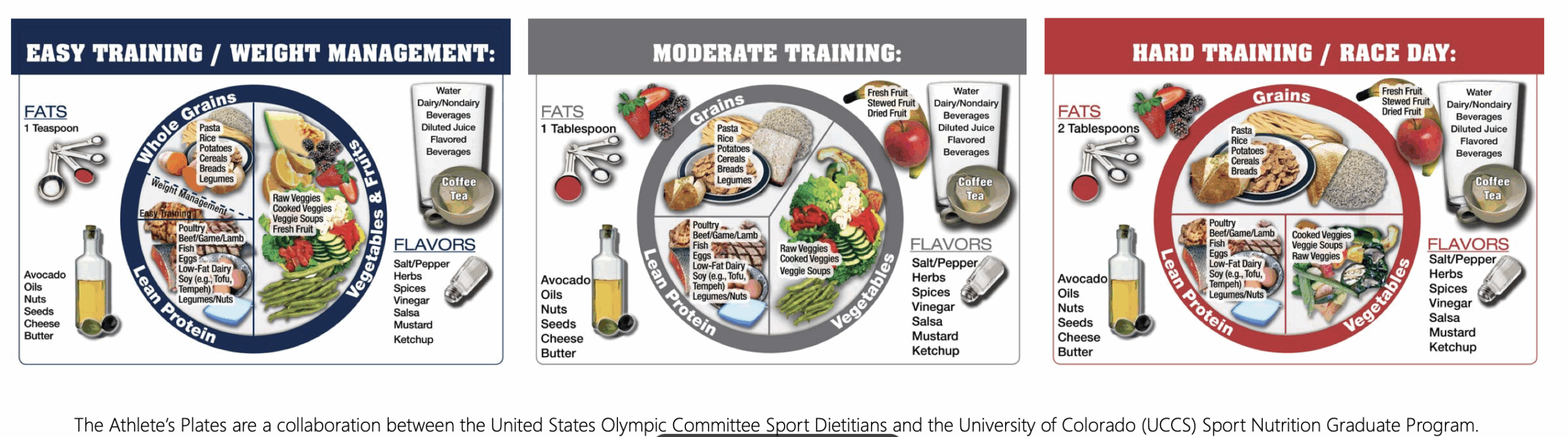
Picture credit: https://www.eiu.edu/herc/Athlete%20Plates%20Easy%20Day%20Handout.pdf
Key Takeaways
- You don’t need fewer calories on rest days. What shifts is the proportion and timing of nutrients.
- Aligning what you eat with what your body is doing (whether training or recovering) helps maintain performance, comfort, and long-term progress.
- Athletes can use the performance plate to guide plate structure/meal composition.
References
- USOPC. Nutrition. www.usopc.org. Accessed November 29, 2025. https://www.usopc.org/nutrition
